
موقع حكومي رسمي تابع لحكومة المملكة العربية السعودية


تنتهي روابط الموقع الرسمي للحكومة السعودية بـ gov.sa
جميع روابط المواقع التعليمية الرسمية في المملكة العربية السعودية تنتهي بـ sch.sa أو edu.sa

تستخدم المواقع الحكومية HTTPS بروتوكولًا للتشفير والأمان.
المواقع الآمنة في المملكة العربية السعودية تستخدم بروتوكول HTTPS للتشفير.


أكثر الكلمات بحثًا
SDG 5.3.2 Policy addressing women’s applications, acceptance/entry
 نُشِر في 2024-10-24
Updated 30/10/2025
5.3.2 Majmaah University’s Policies and Practices for Women’s Access and Participation (2018–2025)
Institutional Commitment and Policy Framework
Majmaah University has demonstrated a strong institutional commitment to women’s access and gender equity, aligned with Saudi Arabia’s Vision 2030 goals. In 2018 (1439 AH), the university established a dedicated Vice-Rector’s Office for Female Student Affairs by directive of the Ministry of Education to promote women’s participation in decision-making roles mu.edu.sa. Since then, this office (led by Dr. Jawaher Al-Omar as Vice President for Female Student Affairs) has overseen the female campus and ensured that policies support women’s empowerment in line with national objectives mu.edu.sa. At the institutional level, Majmaah University explicitly guarantees equal opportunity in admissions and campus life. The university’s Student Handbook states that Majmaah University does not discriminate… on the basis of… sex… in matters of admissions, employment, services or educational programs mu.edu.sa. This anti-discrimination policy, which adheres to national laws, covers all students and staff and commits the university to remedy any such discrimination or harassment promptly mu.edu.sa mu.edu.sa. In practice, admissions policies and procedures are unified for all applicants, male and female. The Deanship of Admission and Registration follows the same criteria and steps for everyone, aiming to “find a seat in the university for each student who fulfills the admission requirements” mu.edu.sa. Male and female students are admitted based on merit and distributed across colleges according to their academic interests and the capacity of each program mu.edu.sa. In other words, women’s applications and entries are handled on an equal footing with men’s, under a common framework (often via parallel application portals for each gender) mu.edu.sa. This institutional framework – clear policies of non-discrimination, unified admissions processes, and a high-level office championing female students – underpins Majmaah University’s commitment to gender equity in access and participation.
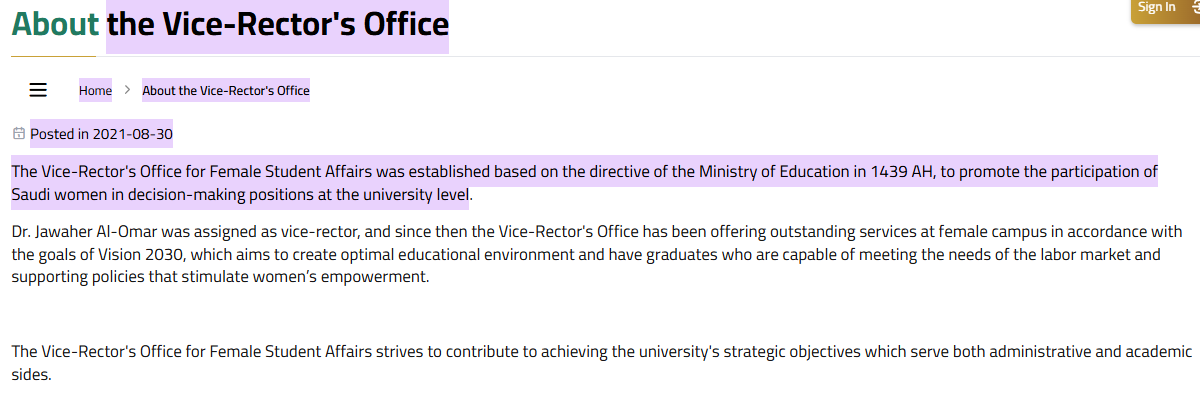
The Vice-Rector's Office
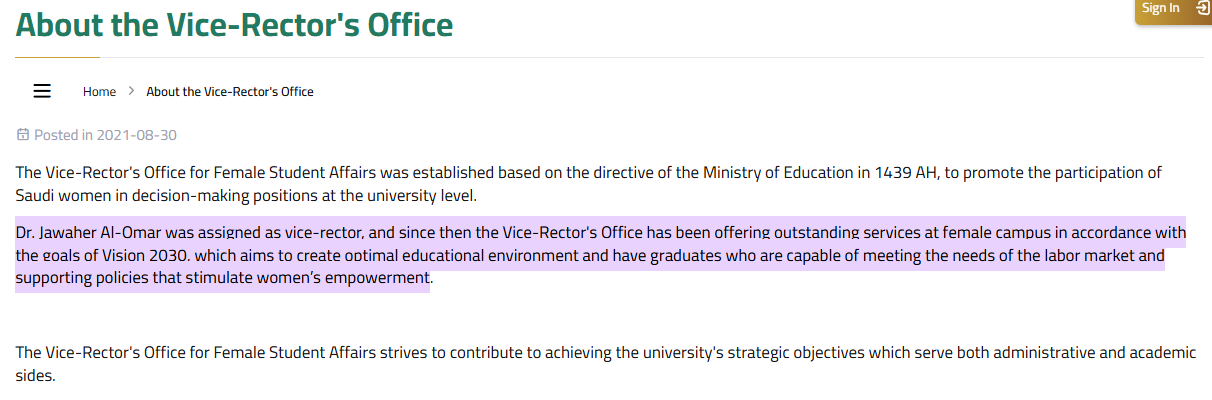
The Vice-Rector's Office for Female Student Affairs was established based on the directive of the Ministry of Education in 1439 AH, to promote the participation of Saudi women in decision-making positions at the university level.
Dr. Jawaher Al-Omar was assigned as vice-rector, and since then the Vice-Rector's Office has been offering outstanding services at female campus in accordance with the goals of Vision 2030, which aims to create optimal educational environment and have graduates who are capable of meeting the needs of the labor market and supporting policies that stimulate women’s empowerment.
The Vice-Rector's Office for Female Student Affairs strives to contribute to achieving the university's strategic objectives which serve both administrative and academic sides.
Discrimination and Harassment
https://www.mu.edu.sa/sites/default/files/content/2020/10/General%20Student%20Handbook.pdf
Majmaah University does not discriminate or permit discrimination by any member of its community against any individual on the basis of race, color, religion, national origin, sex, parental status, marital status, age, disability, citizenship, or any other classification protected by law in matters of admissions, employment, services or in the educational programs or activities it operates. Harassment, ,whether verbal, physical, or visual, that is based on any of these characteristics is a form of discrimination. This includes harassing conduct affecting tangible job benefits, interfering unreasonably with an individual’s academic or work performance, or creating what a reasonable person would perceive is an intimidating, hostile, or offensive environment.
Discrimination
https://www.mu.edu.sa/sites/default/files/content/2020/10/General%20Student%20Handbook.pdf
The Majmaah University adheres to all the Kingdom laws banning discrimination in public institutions of higher education. The University prohibits discrimination against any employee, applicant for employment, student or applicant for admission on the basis of any protected class. Protected classes include: age, color, creed, disability, ethnicity, marital status, or race. This policy covers discrimination in employment as well as in access to educational opportunities.
Discrimination is defined as adverse treatment of an individual based on that individual’s membership in one or more of the protected groups listed above. Therefore, any member of the campus community, guest, or visitor who acts to deny, deprive, or limit the educational, employment, housing and/or social access, benefits, and/or opportunities of any member of the campus community on the basis of their actual or perceived membership in the protected classes listed above is in violation of the University policy on discrimination. All University employees shall report all suspected incidents of discrimination or harassment. When brought to the attention of the University, any such discrimination will be appropriately remedied by the University according to the procedures outlined in this policy.
DEAN OF ADMISSION AND REGISTRATION: APPLYING ONLINE IS MUCH EASIER THAN ANY OTHER TIME
https://www.mu.edu.sa/en/news/general/204126

The Dean of Admission and Registration, Dr. Saud Al-Muqhem, pointed out that the electronic application process for admission was seamless which achieved the university's goal to make admission easy for students.
He also reported the rector's direction that due to the growing number of students who wish to apply, the deadline will be extended. This extension will be from Sunday 01/19/1445 AH to Thursday via the following links :
Male student Link: https://pab.mu.edu.sa/
Female student Link: https://pag.mu.edu.sa/
Dr. Al-Mughem added that the Admission and Registration attempted over the past period to overcome all the difficulties facing students with the admission procedures in different ways including answering their inquiries, listening to their problems directly in the Deanship, via WhatsApp numbers, or the Deanship's e-mail.
Admissions and Registrations
https://www.mu.edu.sa/sites/default/files/content/2020/10/General%20Student%20Handbook.pdf
The Deanship of Admission & Registration deals with admission and registration of new students. The Deanship aims at providing adequate academic information about the university, its faculties and specializations. One of its main aims is to provide academic services to students including completion of Admission & Registration process using modern technological means. It also aims at developing and improving the work performance mechanism, simplifying the procedures, clarifying the rules & regulations and increasing awareness of its applications.
a. Work on finding a seat in the university for each student who fulfills the admission requirements, and to attract the best high school graduates to the university.
b. Exert the efforts to educate students about study and exam rules & regulations through different means within and outside the university.
c. Document students' academic records and working on constantly updating them electronically.
d. Work on developing and adapting the technology available in the Deanship so that students can pursue academic affairs from anywhere at any time.
e. Work on documentation and expedite finalizing the student graduation procedures within the period specified in the University Calendar.
Responsibilities of the Deanship of Admissions and Registration
a. Submitting the total number of students admitted electronically to the University Council, getting approval of the conditions from the University Council, and distributing male and female students in various colleges on the basis of their academic aspirations and the number of students admitted in each college
b. Receiving transfer applications from other universities, processing certificate equalization, and storing information
c. Participating in the examination process for admitting new students and issuing admission notifications and relevant letters
d. Receiving visiting student delegations and providing them with information and newsletters
e. Visiting schools and providing them with the necessary information about admission and registration process
f. Storing and maintaining students’ grades and documents and providing each department with scholarships for their students at the end of each semester
g. Restoring files of the students who had suspended their study and receiving applications of withdrawal and processing them
h. Receiving applications of visiting students from outside the university
i. Participating in the study plan and following up students’ progress in the study plan and documenting his graduation
j. Submitting students’ problems and giving suggestions to the Permanent Committee of Student Problems
k. Executing the decisions of the University Council, college’s councils, the Permanent Committee of Student Problems and the Disciplinary Board
l. Making modifications concerning students’ names and identification cards based on the university’s policies and procedures
m. Issuing the academic reference forms to be used outside the kingdom of Saudi Arabia.
n. Coordinating the process of students’ transfer from one college to another with a follow up of course equalization
o. Issuing grade reports, academic records, students’ certificates, document, and graduate guides and documenting them
p. Making automatic registration, issuing students’ schedules and attendance sheets, and sending them to the respective colleges.
q. Receiving and replying to inquiries from various colleges concerning registration and issuing result forms at the end of each semester
r. Processing the lists of graduates and those who have registration problems and issuing student identification cards.
s. Depositing student allowances in their accounts at the end of each month and distributing the ATM cards through the respective colleges.
t. Providing the Deanship responsible for the graduation ceremony with the necessary information needed
Admissions of Prospective Students
The University Council determines the number of students to be admitted for the upcoming academic year on the basis of the recommendations presented by the College Councils and the respective departments at the college.
The Deanship of Admissions and Registration Affairs receives the applications for admission in accordance with the following conditions:
a. The applicant should have his/her high school certificate or an equivalent certificate from inside or outside Saudi Arabia. The university council determines qualifying certificates for admission at any of its departments
b. The applicant should have obtained the secondary school certificate, or its equivalent, in a period of less than five years prior to his/her application. However, the University rector may waive this condition if the applicant has a persuasive explanation.
c. The applicant be medically fit.
d. The applicant should successfully pass any examinations or interview deemed necessary by the University Council.
e. The applicant must obtain the approval of his/her employer, if he/she is an employee in any government or private institution.
f. The applicant must satisfy any other requirements specified by the University Council at the time of application.
g. BA holders may not be admitted to the university to obtain another BA degree, however, the university rector may waive this condition.
h. Applicants who are currently enrolled at another institution or the university itself may not be accepted.
a. The students must undergo the necessary tests held by the National Center for Measurement and Assessment.
b. The student must read the admission conditions through the university electronic gate or the Deanship of Admission and Registration website http://w1.ksm- admit.net/
c. The students fill in the form with the necessary data and the desired courses of study through the e-admission website within the allotted period of time.
d. When the period of admissions is over, the students will be admitted on the basis of those who have met all the admission requisites and those who have not. Admissions depend on the equivalent average and the desired college.
e. Passing the personal interview is a must in some colleges.
f. After the respective evaluation, admitted students are informed through e-mail and mobile messages (SMS). The students receive information about the colleges and fields of study where they were selected. Admitted students must visit their accounts through the university electronic gate to print the form of nomination and the application form.
The students can automatically register the desired courses during every academic semester. The students may enter the academic system gate by using a user name and password to cancel courses, add courses, modify the schedule, confirm registration and print the schedule. The student must confirm his registration within the first week of the semester. The minimum load is (12) units and the maximum is (20) units.
The student who is not willing to study in the first semester or in any semester must apply for withdrawal, otherwise he will fail in the courses of that semester. If the student encounters any problems concerning his registration, he must go to his academic guide or to the Student Affairs office in the college
Initiatives to Promote Women’s Access and Enrollment
Over the past 5–7 years, Majmaah University has introduced targeted initiatives and support structures to encourage women’s access to higher education. One notable practice is the provisioning of additional admission opportunities for female students. For example, ahead of the 1444 AH academic year (2022), the Deanship of Admission & Registration announced an “additional admission” round exclusively for female applicants, extending the application deadline and inviting more women to enrollmu.edu.sa. This effectively acted as a quota or special intake to accommodate the growing number of qualified female candidates. The university also engages in outreach and pipeline development for prospective female students. Admission officials conduct school visits to provide information on the application processmu.edu.sa, ensuring that high school girls are aware of Majmaah’s programs and entry requirements.
Additional Admission for Female Students
The Deanship of Admission and Registration at MU announces that additional admission is open for female students for the academic year 1444. To apply, please visit this link: https://admit.mu.edu.sa
Deadline for applying on Tuesday 18-01-1444

Beyond general outreach, the university’s faculty and centers actively support young women’s interest in higher education and STEM fields. In 2022, Majmaah’s Innovation and Entrepreneurship Center faculty (both women and men) mentored and supervised talented female high school students in the National Olympiad for Scientific Creativity (“Ibda’a” competition) mu.edu.sa mu.edu.sa. Through such community initiatives, the university encourages girls to pursue scientific research and innovation, aligning with the Kingdom’s efforts to inspire more women to enter scientific and technical disciplines.
The Innovation and Entrepreneurship Center participates in supervising female students participating in the National Olympiad for Scientific Creativity.
A group of elite academics and specialists from the university participated in the research supervision of talented female students participating in the National Olympiad for Scientific Creativity "Ibd'a" for the year 2022, which is organized by the Ministry of Education and the King Abdulaziz and His Companions Foundation for Giftedness and Creativity "Mawhiba", in implementation of the education policy in the Kingdom to encourage and develop the spirit of research and scientific thinking, as the Olympiad comes in an effort to create a competitive, creative scientific environment that stimulates the mind of the scientific researcher, and prepares him to compete and enter the global knowledge system based on innovation and scientific research to achieve sustainable national development.
The University's Innovation and Entrepreneurship Center held a number of meetings to introduce the National Olympiad for Scientific Creativity and to follow up on the developments in female students' projects. A group of faculty members from different specializations participated from the university, namely: Dr. Abdulaziz Al-Mutairi from the College of Engineering, Dr. Fadia Al-Mutairi from the College of Computer Science and Information Technology, Dr. Hoda Hakim from the College of Medicine, Dr. Amani Hassan from the College of Science, Dr. Warda Al-Haqil from the College of Education, Ms. Hajar Al-Mujahed from the College of Science, and Ms. Ashwaq Al-Mutairi from the College of Education.
It is worth noting that the National Olympiad for Scientific Creativity is an annual scientific competition targeting middle and high school students. It is based on competition in one of the scientific fields, through the presentation of individual scientific projects according to the required special standards and controls. Projects are judged according to specific scientific criteria with the aim of identifying outstanding projects for nomination to the higher competitive stages.
This participation comes with the support of His Excellency the University President, Professor Dr. Saleh bin Abdullah Al-Muzal, and the follow-up of the University Vice President for Female Student Affairs, Dr. Jawaher bint Abdulrahman Al-Omar, to strengthen the research and innovation system and focus on achievements in various fields of science and knowledge.

Financial support is another pillar of access. Majmaah University provides scholarships and internal funding programs that benefit female students. Within the Deanship of Student Affairs, a dedicated Female Student Fund Unit offers financial assistance to women during their studies mu.edu.sa. This unit helps cover study-related needs and extracurricular participation by awarding prizes, providing loans or emergency aid to eligible students, and even supplying medical equipment for students with special needs mu.edu.sa. Such measures help reduce financial barriers for female students, enabling them to enroll and continue their education. In addition, the university offers merit-based and need-based scholarships to both Saudi and international students (with equal opportunity for women), as well as internal and external scholarship programs for non-Saudi residents mu.edu.sa. While not exclusively for women, these scholarship programs have seen substantial female participation, further supporting women’s access to higher education.
Female Student Fund Unit
This unit is responsible of helping students financially during their study period as well as meeting students’ needs to take part in extracurricular activities. The responsibilities of the unit include:
· Contribute in improving student activities and motivating students for participation by awarding them prizes.
· Supervise the process of photocopy and textbook sale.
· Give a loan and financial assistance to students who are eligible based on the stipulated regulations.
· Provide medical equipment for student with special needs.
Internal Scholarships
What Are Internal Scholarships?
Welcome to Majmaah University’s Internal Scholarships Program — designed for non-Saudi students residing in the Kingdom of Saudi Arabia.
If you are eager to pursue your undergraduate degree, we invite you to apply for a scholarship opportunity with either full or partial benefits, based on the university’s approved regulations.
Academic Programs
Choose an academic program that matches your passion and goals, and start your academic path with certainty and excitement.
How to Apply
Ready to join Majmaah University?
You can easily apply through our Academic Portal and explore the programs we offer.
Admission Guide
For complete details about the Internal Scholarships Program, download our Admission Guide here:
https://www.mu.edu.sa/sites/default/files/2024-07/
The university also runs mentoring and preparatory programs to smooth the transition of women into university life. Academic advising is emphasized as a critical support mechanism – each college (including the female sections) assigns academic advisors to guide students on course selection, degree requirements, and career planning mu.edu.sa mu.edu.sa. For instance, in the College of Applied Medical Sciences’ nursing department, advisors work closely with female students on their academic progression and professional preparation mu.edu.sa. These advising and counseling services ensure that women (often first-generation university students) receive guidance to navigate university requirements successfully. Overall, through special admissions rounds, outreach to schools, financial aid units, and robust advising, Majmaah University has put in place concrete support structures to promote women’s access and successful enrollment.
Academic Advising:
Academic advising is a key to success for growth and global stand of any higher educational institution. At the faculty of Department of Nursing, College of Applied Medical Sciences (CAMS), Majmaah University, AlMajmaah, academic advisers are treated as valuable assets to student’s community as they plan their undergraduate career and, finally, prepare for graduation to meet the demands of the market industry. Academic advising is a legitimate process that stands for guiding the students / Advisee on different issues related to their academic advancement and to help them find solutions to different academic problems.
Academic advising is related to assisting students with educational decision, degree requirements, academic policies/ procedures, as well as broader concerns such as career and graduate institutional options in the Major. Academic advising synthesizes and investigate students' educational experiences within the structure of their ambitions, abilities and lives to extend learning beyond campus boundaries and time frames. This Academic advising system is based on Four Stakeholders involved in the process of Academic advising at the Faculty of Department of Nursing , College of Applied Medical Sciences, Majmaah University are:
1) The Advisee / Students.
2) The advisor / Counsellor (faculty member Played as Academic Advisor or Career Advisor).
3) The Head of the Academic Advising Unit/Committee.
4) And the Department counsel / Program.
Role of the Academic Advisor and Advisee / Student:
An Academic Advisor is a faculty member of the Department for the process of guiding the students / Advisee on various affairs related to their current academic and future progress. Following are some of the responsibilities designate for the Academic Advisor:
(1) Advising the undergraduate students regarding curriculum study plan relevant to the Program at the faculty of Department of Nursing.
(2) Analyze, view and sign the check sheet after each semester to examine the progress of a student.
(3) Arrange, administer and announce open days on an annual basis.
(4) Direct student orientation and advising services.
(5) Coordinated internship and abroad study (Career advising).
(6) Welcomes and Manages the student transfer system (inter departmental or international).
(7) Monitoring the student absenteeism percentage to prevent semester detention.
(8) Advisor administer the online feedback system for various outcomes of the program, course and other services on time by utilizing the electronic Educate system.
(9) Advisors also provides information and guidance to outgoing students to seek an interview at reputed hospitals for Internship training.
Trends in Women’s Admission and Participation
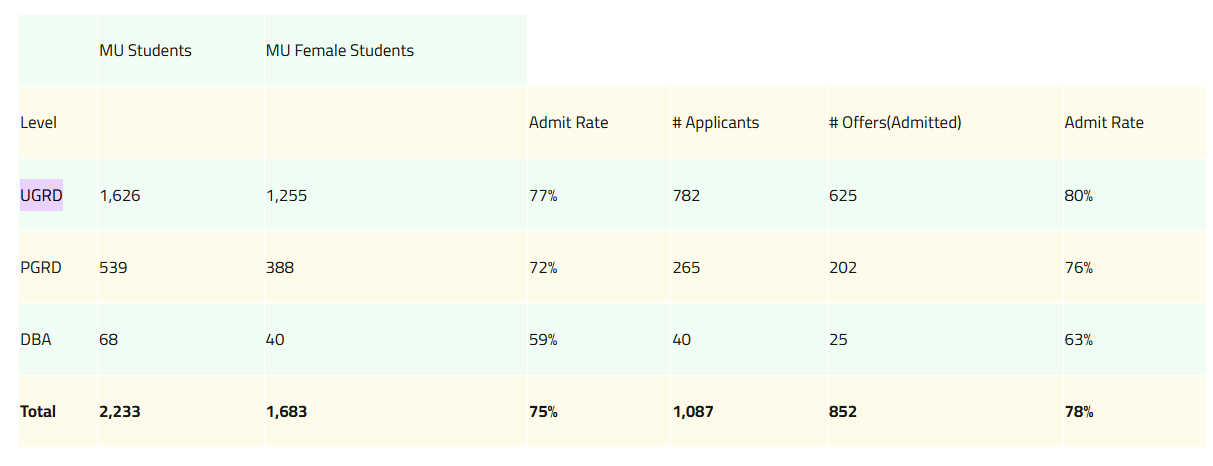
Data from recent years indicate a dramatic increase in women’s participation at Majmaah University, approaching parity with men in many areas. Female students now comprise nearly half of the student body. In the 2022/2023 academic year, women constituted about 48% of all enrolled students (2,129 female out of 4,444 total students) mu.edu.sa. This near-equal gender balance represents significant progress, considering that a decade ago Saudi higher education had male-majority enrollments. The numbers also show that female students have high rates of admission and academic success. Majmaah systematically tracks application and acceptance rates by gender: for example, in the 2022–23 admissions cycle, the admission rate for female applicants was slightly higher than the overall average. At the undergraduate level, 83% of female applicants were admitted, compared to an 81% admit rate overall mu.edu.sa mu.edu.sa. Similar trends appeared in graduate programs – for instance, female postgraduates had about an 81% acceptance rate versus 77% overall mu.edu.sa. These figures demonstrate that women are not only applying in large numbers but also gaining entry at rates on par with (or better than) their male counterparts, suggesting equitable access in practice.
Numbers of Students
https://www.mu.edu.sa/sites/default/files/2024-01/
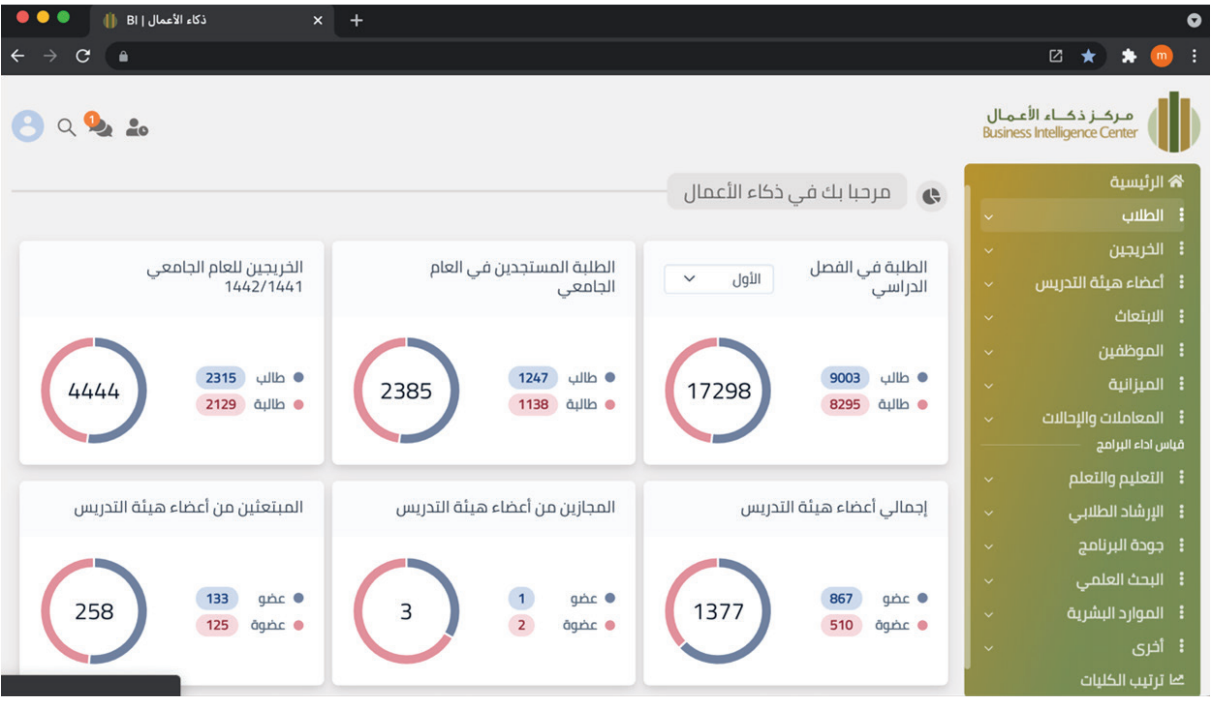
As shown in the above table, the number of male students are 2315 of the total students’ number which is 4444. So, the percentage of the male students is 52% and 48$ refers to the females.
The numbers show that female students are almost half of the university students.
2022-23 and Fall 2022-23 Admit Rates: Overall and Female applicants
Fall 2022-23 only
Once enrolled, female students are persisting and graduating in strong numbers as well. In the most recent academic report, approximately 45% of the university’s graduates are female mu.edu.sa. During 1443–1444 AH, out of 6,803 total graduates, 3,044 were women mu.edu.sa. This proportion – nearly half – indicates that women’s completion rates are keeping pace with their enrollment rates. Indeed, the university notes that “female students are almost half of the university students” and similarly around half of each graduating cohort mu.edu.sa mu.edu.sa. Over the last 5–7 years, this percentage has been steadily rising as more programs open to women and as societal changes encourage female education. Women at Majmaah University are also branching into diverse academic disciplines and student activities. They are enrolled across all 11 colleges and 49 academic programs, from traditional fields like education and arts to STEM fields like engineering, computer science, and medicine, reflecting broadened opportunities. Female students are active in campus life: the Deanship of Student Affairs supports numerous student clubs and councils with female membership (e.g. cultural clubs, volunteer initiatives, and student advisory councils) mu.edu.sa mu.edu.sa. Female participation in student leadership has grown – for instance, women serve on the Student Advisory Committees that provide input to university administration mu.edu.sa. The university even held an “Achieve Your Ambition” initiative meeting in 2023, hosted by the College of Education, to encourage female students’ leadership development and ambitions mu.edu.sa. These trends in data and involvement show that women at Majmaah are not only gaining admission in greater numbers, but also fully engaging in academic programs, student life, and successfully completing their studies.
(1/4/1) Total Number of Students (New – Enrolled – Graduates)
https://www.mu.edu.sa/sites/default/files/2024-01/
Table (1/1/4/1) shows the distribution of new students, enrolled students, and graduates at the university during the academic year 1443/1444 AH, categorized by academic status, nationality, and gender.
Table (1/1/4/1): Distribution of new students, enrolled students, and graduates at the university categorized by academic status, nationality, and gender during the academic year 1443/1444 AH.
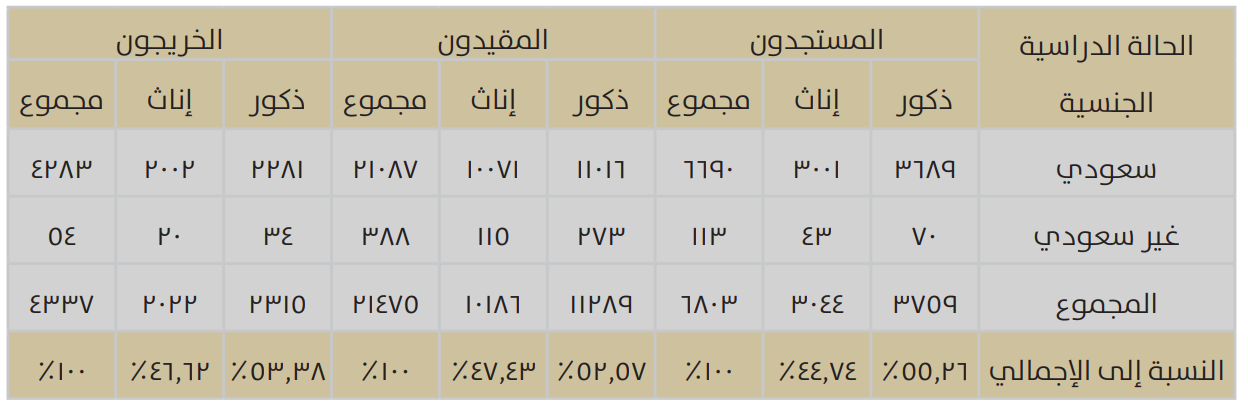

As shown in the above table, the number of graduated Saudi female students is 3001 of the total students’ number which is 6690. So, the percentage of the graduated female students is 45% and 55$ refers to the females.
On the other hand, the overall number of graduated female students is 3044 of the total students’ number which is 6803. So, the percentage of the graduated female students is 45%.
As a result, we notice that the percentage of the graduated female students is almost the half of the overall students’ number.
Figure (2/1/4/1): Percentages of new, enrolled, and graduate students at the university during the academic year 1443/1444 AH.
https://www.mu.edu.sa/sites/default/files/2024-01/
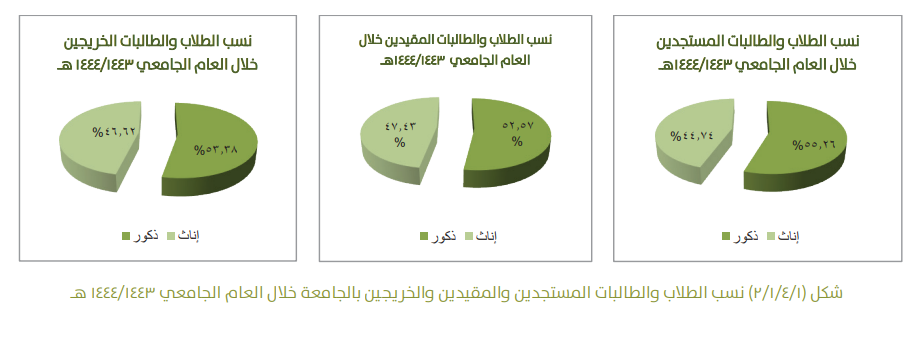
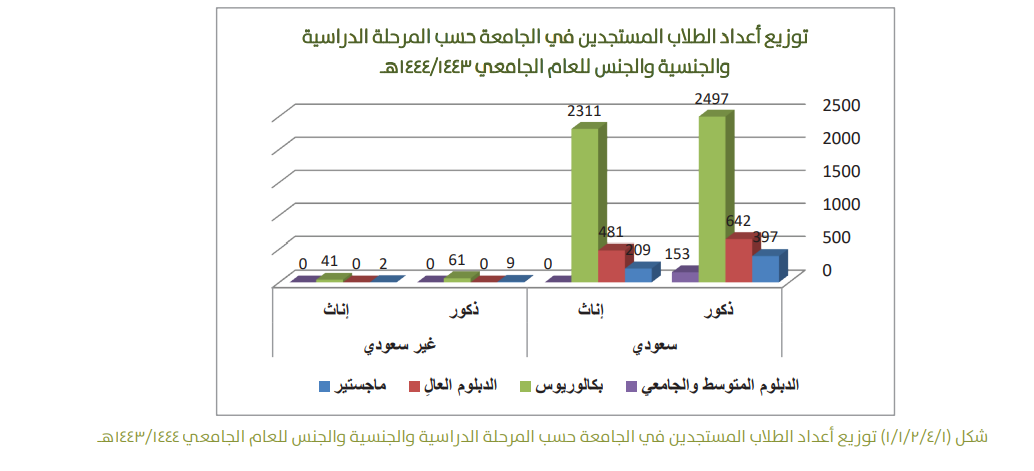
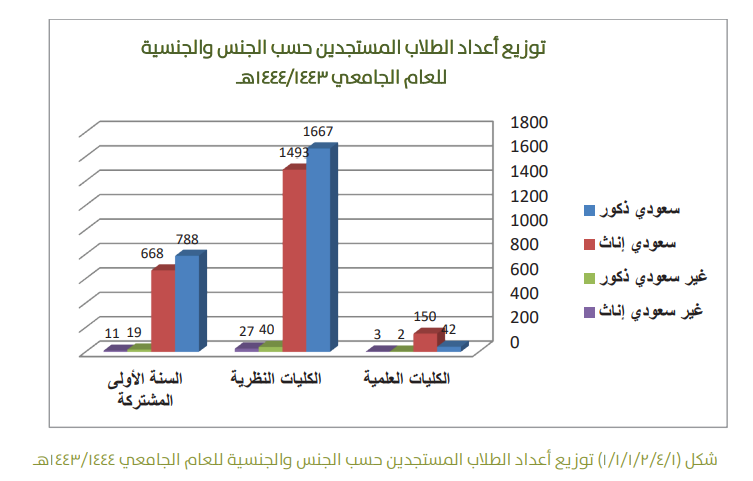
Figure (1/1/2/4/1): Distribution of the number of new students at the university by academic level, nationality, and gender for the academic year 1443/1444 AH.
https://www.mu.edu.sa/sites/default/files/2024-01/
https://www.mu.edu.sa/sites/default/files/2024-01/
Inclusive Campus Environment and Support for Women
Majmaah University has taken deliberate steps to ensure an inclusive and supportive campus environment for female students and staff. A key element is the physical and administrative infrastructure of a women’s campus (female sections) for nearly all colleges. The female campus provides women with the same facilities and resources as the male campus – modern classrooms, laboratories, libraries, and extracurricular spaces – while operating within cultural norms of gender segregation. Under the leadership of the Vice President for Female Student Affairs, the university has worked to create an “optimal educational environment” for women that is welcoming and empowering mu.edu.sa. The campus culture is explicitly free from gender-based discrimination or bias. University statements affirm that female students have “the same educational opportunities as their male counterparts” and are judged based on ability and dedication rather than gender mu.edu.sa. This ethos is reinforced by strict policies: any form of gender discrimination or harassment is prohibited, with clear procedures for reporting and addressing violations mu.edu.sa mu.edu.sa. These policies apply to students, faculty, and staff alike, fostering a climate of mutual respect.
Discrimination and Harassment
https://www.mu.edu.sa/sites/default/files/content/2020/10/General%20Student%20Handbook.pdf
Majmaah University does not discriminate or permit discrimination by any member of its community against any individual on the basis of race, color, religion, national origin, sex, parental status, marital status, age, disability, citizenship, or any other classification protected by law in matters of admissions, employment, services or in the educational programs or activities it operates. Harassment, ,whether verbal, physical, or visual, that is based on any of these characteristics is a form of discrimination. This includes harassing conduct affecting tangible job benefits, interfering unreasonably with an individual’s academic or work performance, or creating what a reasonable person would perceive is an intimidating, hostile, or offensive environment.
To support women’s full participation, Majmaah has established various centers and services tailored to female students’ needs. Within the female campus, the Deanship of Student Affairs operates units such as the Female Student Guidance and Counseling Center, a Disability Care Center, and the Female Student Fund Unit. The counseling center offers academic and personal guidance to female students, helping them navigate any challenges and providing mentorship programs (e.g. workshops like “Be Positive” to promote confidence and positive thinking for female students) mu.edu.sa. The Disability Care Center ensures that female students with disabilities receive proper accommodations and assistive equipment so they can fully participate in classes mu.edu.sa. Meanwhile, the Female Student Fund Unit, as mentioned, addresses financial and logistical needs from textbook assistance to emergency loans mu.edu.sa. Furthermore, female sections have dedicated female staff and administrators (such as vice-deans and coordinators) to manage student services, which helps create a comfortable environment where female students can seek support.
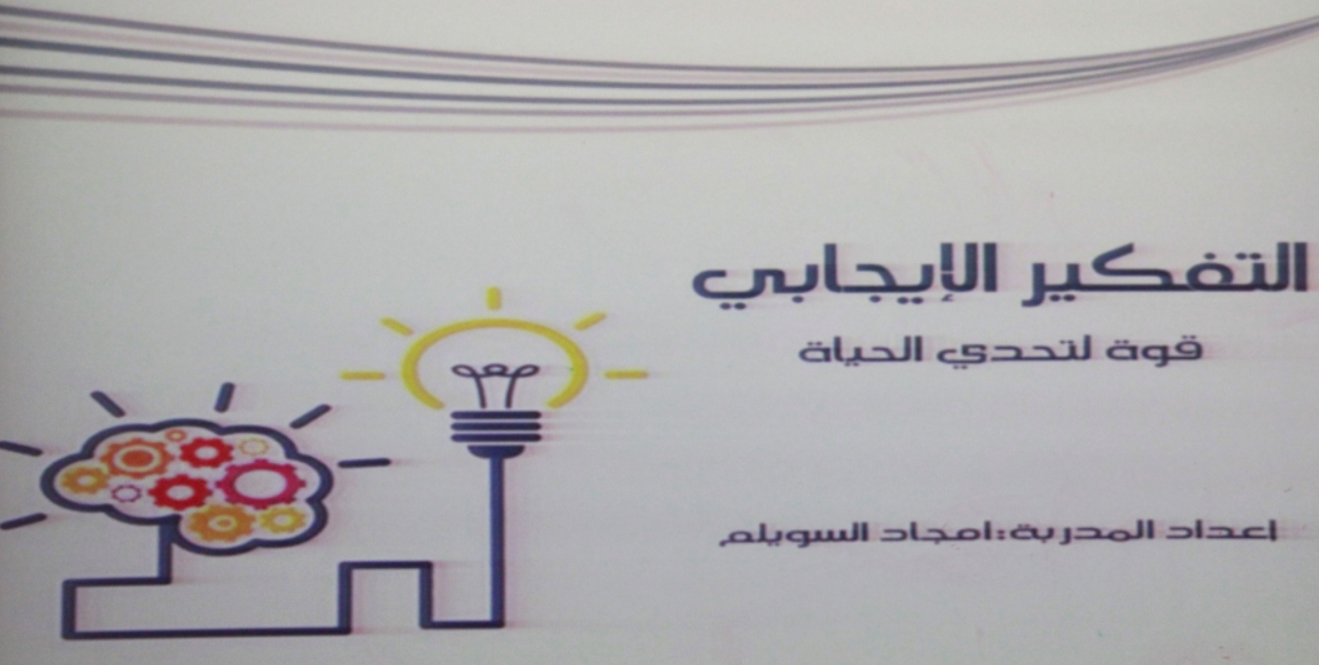
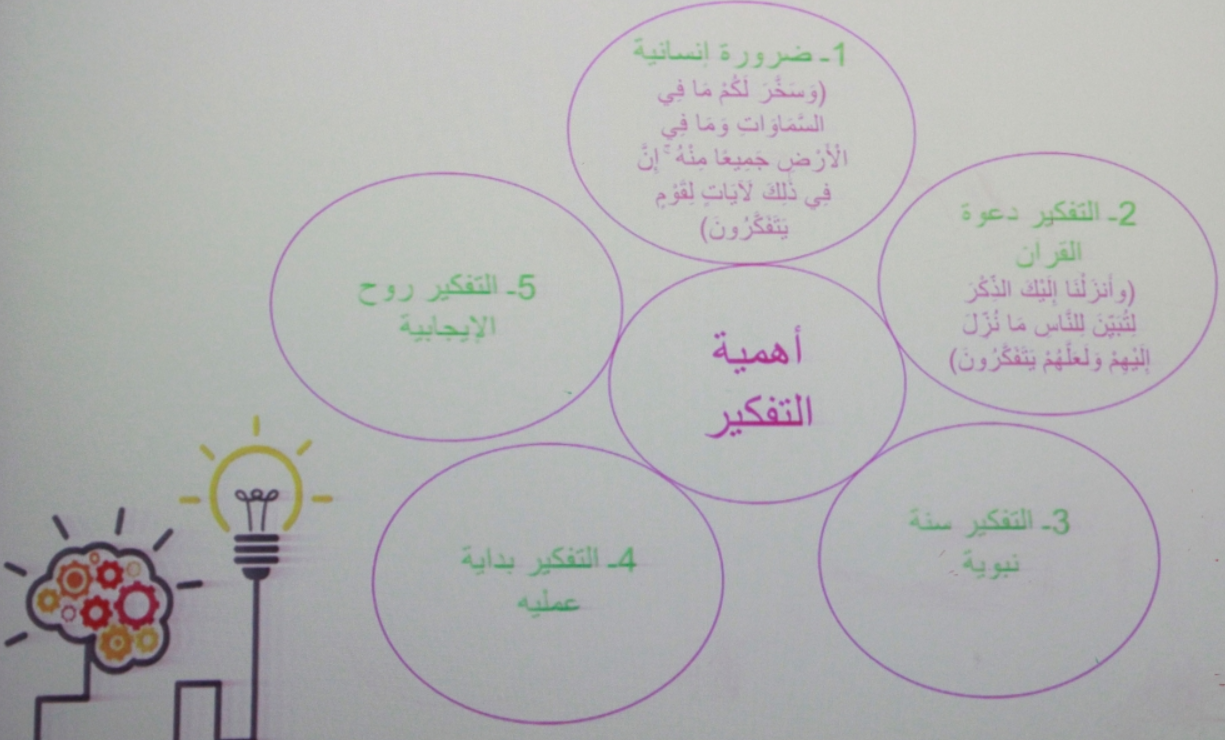
A Guidance Program for female students entitled "Be Positive"
On Tuesday 21/2/1440 H, at the Training Hall, the Counseling and Guidance Unit at Female Students Department, organized a program for female students entitled "Be Positive". Ms. Amjaad Al-Suwailam presented the program in which she mentioned the meaning and importance of thinking, the meaning of positivism and the basics and skills of positive thinking.
The university has also implemented programs to make campus life more inclusive and enriching for women. This includes providing safe transportation and facilities (with supervised bus services for female students commuting, and separate recreational spaces), as well as organizing events that celebrate women’s achievements. For example, Majmaah University’s female sections commemorate International Women’s Day with special programs. In 2021, the College of Education’s female section held a day-long virtual celebration of International Women’s Day, involving all departments, to recognize women’s contributions mu.edu.sa. Additionally, workshops on “Women’s Rights and Duties” have been organized to educate the university community about gender rights, covering topics from women’s right to education and work to their legal rights in society mu.edu.sa mu.edu.sa. These educational events not only raise awareness but also signal the institution’s commitment to empowering female students with knowledge about their societal roles and protections. Importantly, the university’s efforts extend to ensuring women’s inclusion beyond campus into the workforce. In 2023, Majmaah University signed a cooperation agreement with the Ministry of Human Resources and Social Development aimed at supporting women’s job empowerment and increasing their participation in the Saudi labor market mu.edu.sa. This agreement launched a “parallel training” initiative to improve female graduates’ employment prospects through on-the-job training and skill development, targeting the employment of thousands of Saudi women by 2025 mu.edu.sa. By bridging female students to career opportunities and promoting an inclusive educational setting, Majmaah University works to ensure that women not only gain admission but also thrive on campus and beyond.
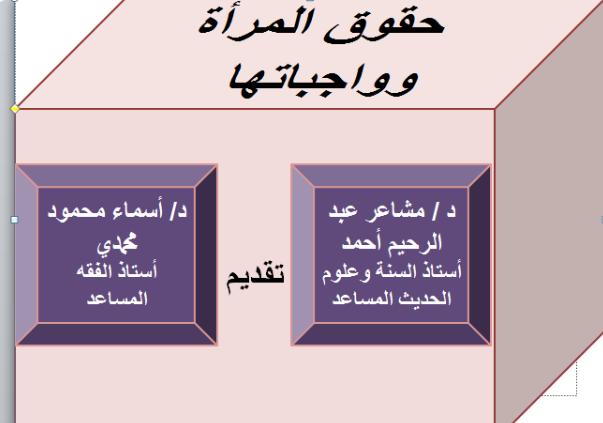
Women's rights and duties
As part of the training unit’s activities, the unit organized an event entitled : (Women’s Rights and Duties )
Activity summary:
The course began with an introduction to women's rights, then an introduction to the status of women in other societies (Greece, Romans, India, Jews, Christians, then the status of women in pre-Islamic times and Islam). Then an introduction to women's rights: their right to education and upbringing, their right to participate in life, their right to choose a husband and their right to a dowry, then their right to support, then their rights if divorce occurs.
As for her duties: We talked about the fact that a woman is obligated – in general – to do what a man is obligated to do, except in matters that are specific to men, in which case she is obligated to fulfill the legal obligations. Then we talked about what she is obligated to do as a wife and her duties as a mother towards her children.
Activity objectives:
Knowing women's rights and duties.
Learn about the status of women among other nations.
Understanding the status of women in Islam.
Learn about women's rights.
Learn about women's duties.
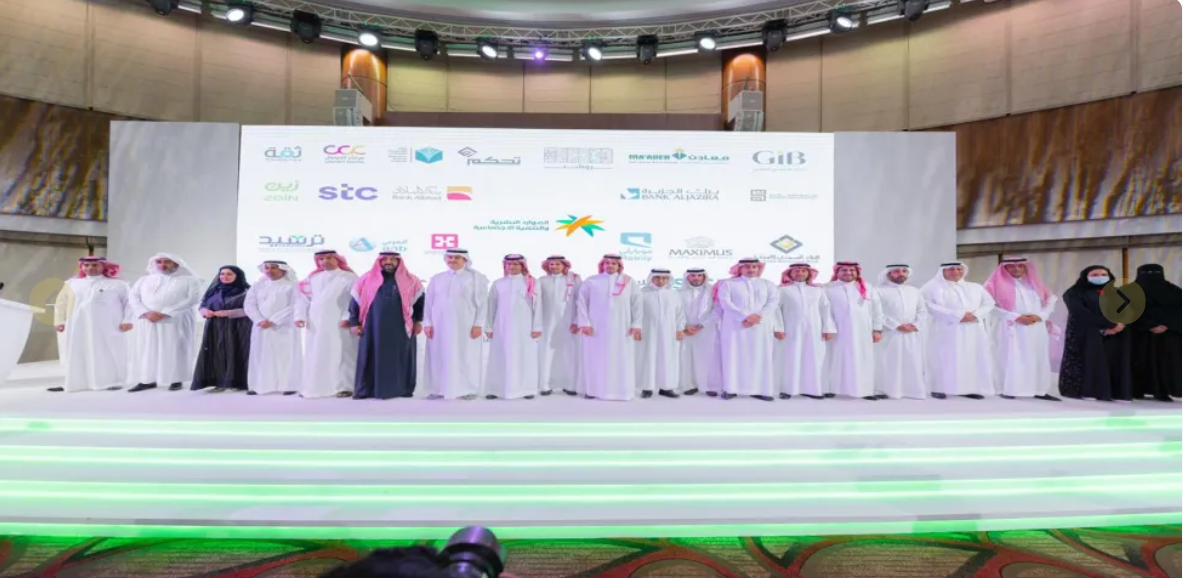
The university signed a cooperation agreement with the Ministry of Human Resources and Social Development to support women's career empowerment and increase their participation in the Saudi labor market.
The university signed a cooperation agreement with the Ministry of Human Resources and Social Development. This agreement aims to support women's career empowerment and increase their participation in the Saudi labor market through the launch of the Parallel Training Initiative.
The Memorandum of Understanding was signed on behalf of the university by His Excellency the Vice-Rector of Majmaah University, Professor Dr. Musallam bin Mohammed Al-Dosari, and on behalf of the ministry by the Undersecretary for Saudization Affairs, His Excellency Eng. Majid Al-Dahwi. The signing of the agreement was attended by His Excellency the Deputy Minister of Human Resources and Social Development, Dr. Abdullah bin Nasser Abuthnain; the President of Majmaah University, Dr. Saleh bin Abdullah Al-Mizal; and the Dean of the Institute of Studies and Consulting Services, Dr. Saad bin Mohammed Al-Rashoud.
The terms of the agreement include the Parallel Training Program, an initiative under the transformation programs of the Kingdom's Vision 2030, which aims to support women's career empowerment and support female job seekers with employment and on-the-job training. The program aims to employ and train no less than 100,000 female citizens with a bachelor's degree or higher. The program will continue until the end of 2025, to increase their economic participation rate and raise the skills level of the Saudi workforce.
Women’s Representation in Governance, Administration, and Faculty
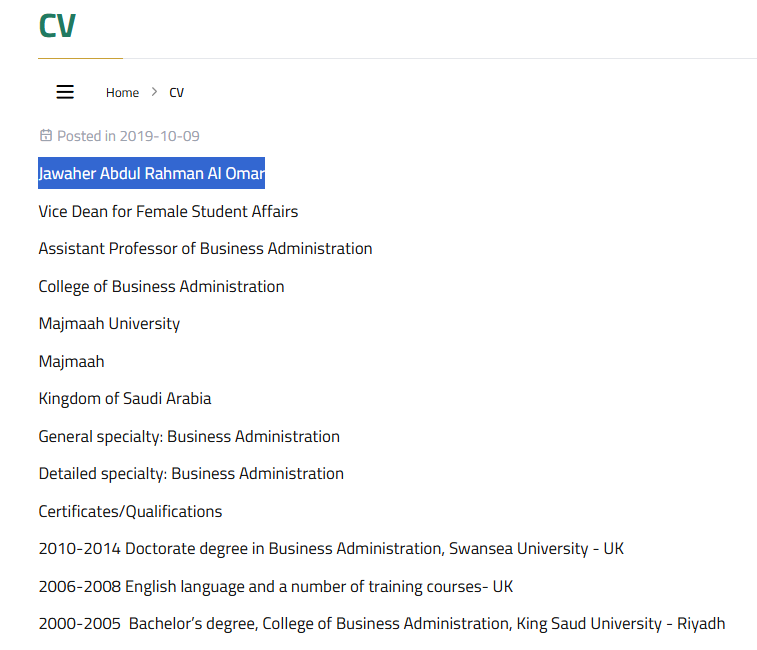
Women hold significant roles in Majmaah University’s governance and academic staff, reflecting deliberate policies to increase female representation. At the executive level, the creation of the Vice Presidency for Female Student Affairs itself placed a woman in a top leadership position. Dr. Jawaher bint Abdulrahman Al-Omar, an Assistant Professor of Business Administration, serves as Vice President (Vice-Rector) for Female Student Affairsmu.edu.sajournals.sagepub.com. Her appointment was part of the initiative to include Saudi women in university decision-making, and she sits on the university’s senior management council. Under her office, many administrative posts on the female side are likewise occupied by women. Each college typically has a female Vice-Dean or Head for the women’s section – for example, colleges have female vice-deans for academic affairs or student affairs who coordinate parallel to the male deansmu.edu.sa. Women also lead various support departments and units; e.g. the Supervisor of the Female Students’ Counseling Unit and the heads of female student clubs are women, ensuring that female perspectives guide student servicesmu.edu.sa.
In faculty positions, female academics are well-represented across disciplines and are actively contributing to teaching and research. Majmaah University employs women as lecturers and professors in fields ranging from the humanities to the sciences. Female faculty members can be found in the College of Medicine, College of Science, College of Business Administration, College of Education, College of Computer Science & IT, and more mu.edu.sa. These women are not only teaching courses but also serving as mentors and role models. The university highlights the presence of “successful female faculty members and administrators” as tangible role models who show current students what women can achieve in academia and leadership mu.edu.sa. For instance, women faculty like Dr. Thuraya Al-Saif, Dr. Mona Jaber Ahmed, Dr. Dalal Abdel Aal, and others have led high-profile workshops and initiatives on campus (in areas such as leadership, entrepreneurship, and citizenship values) mu.edu.sa mu.edu.sa. The involvement of these female experts in university-wide programs helps challenge stereotypes and inspire young women to pursue diverse career paths mu.edu.sa.
Women also participate in university governance through councils and committees. There are female representatives in the University Council and various academic committees, especially those related to female education. Notably, Dr. Jawaher Al-Omar and other female administrators regularly engage with counterparts from other institutions to advance women’s leadership in academia – for example, Dr. Al-Omar has taken part in national “Women Leaders” meetings and summits aimed at shaping the future of female leadership in higher education mu.edu.sa portal.mu.edu.sa. This external engagement, combined with internal governance roles, means women have a voice in decision-making at Majmaah University from the departmental level up to university-wide strategic planning.
The University Agency for Female Student Affairs concludes a series of workshops on developing and refining entrepreneurial skills to enhance women's leadership and strategic role at the university.
Under the patronage of the University President, Professor Saleh bin Abdullah Al-Mazal, the University Vice-President for Female Student Affairs held a series of workshops dedicated to developing and refining entrepreneurial skills to enhance women's leadership and strategic role at the university during the second semester of the academic year 1444 AH, as part of the "Civilized Saudi Woman" initiative.
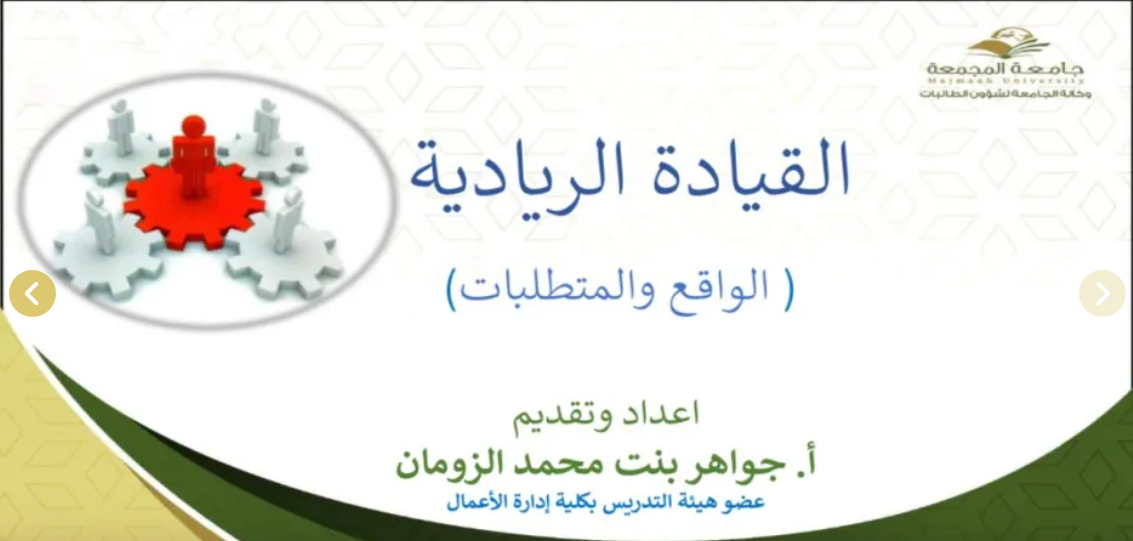
The workshops were presented over a period of two weeks and were attended by (215) female university staff. The Vice President for Female Student Affairs opened the session on the importance of the pioneering role of Saudi women during the reign of the Custodian of the Two Holy Mosques, King Salman bin Abdulaziz, may God protect him, and the importance of acquiring entrepreneurial skills in accordance with the ambitious vision of the Kingdom of Saudi Arabia 2030. The activities began with a workshop entitled (Entrepreneurial Leadership Transformation and Change Management), presented by Her Excellency Dr. Mona Jaber Ahmed, a faculty member at the College of Sciences and Humanities in Al Ghat. This was followed by the second workshop presented by Her Excellency Dr. Dalal Abdel Aal, a faculty member at the College of Business Administration, entitled Entrepreneurial Behavior (Entrepreneurial and Creativity Skills). Finally, the workshops on developing and refining entrepreneurial skills were concluded with a workshop entitled: Entrepreneurial Leadership (Reality and Requirements), presented by Professor Jawaher bint Muhammad Al-Zoman, a faculty member at the College of Business Administration. All the workshops addressed the importance of entrepreneurial leadership and the role of women in creating change and creativity within the Kingdom’s vision 2030.
In conclusion, the Vice President for Female Student Affairs expressed her gratitude and appreciation for the University President's support and patronage, and for everything that would develop and refine women's skills and their strategic leadership role at Majmaah University. She also thanked the workshop presenters, female faculty members, for their enriching presentations and the generous attendees for their participation and interaction.
In summary, women’s representation at Majmaah University has grown substantially in recent years: a woman heads the female student affairs at the executive level mu.edu.sa, women serve as vice-deans and directors of key units, and female scholars are present across faculties, providing mentorship and leadership. This breadth of representation ensures that female perspectives are integrated into governance and academia, reinforcing the university’s ethos of gender-inclusive progress. Majmaah University’s practices over the last 5–7 years illustrate a comprehensive approach – from policy to implementation – to supporting women’s applications, admissions, and participation in higher education, aligning with the metrics and spirit of the Times Higher Education Impact Rankings on gender equality.

شارك برأيك وساهم في تحسين خدماتنا.
أعجب 0 من 121 زائر بمحتوى الصفحة. (0% مؤشر رضا الزوار)